


Noam Wolf | Oct 19, 2026 | 11:24 PM
Choosing between Los Angeles wedding venues for live music comes down to four things a site tour almost never covers: power, load-in, the footprint the band actually stands on, and the hour your amplified sound has to stop. Every other detail of the room can be perfect and any one of those four can quietly reshape your evening. This guide is written from the working side of the load-in door, and it tells you what to ask before you sign.
Written by Noam Wolf, founder of Sunny Entertainment, a Los Angeles entertainment company that books bands, DJs, string ensembles and specialty acts for weddings and events. The power and space guidance comes from our own technical rider and the questions our team asks venues before a booking, and every price is Sunny Entertainment's own 2026 Los Angeles pricing. Last updated October 2026.
| Venue type | What it usually gives a band | What to confirm before you sign | Most common constraint |
|---|---|---|---|
| Historic hall or former church | Indoor volume, real acoustics, a defined focal point | Circuit count and whether power is shared with lighting | Older electrical panels and tight load-in doors |
| Hotel ballroom | House power, loading dock, an in-house AV partner | Whether in-house AV is required and what it charges | Union or exclusive vendor rules, and ceiling height |
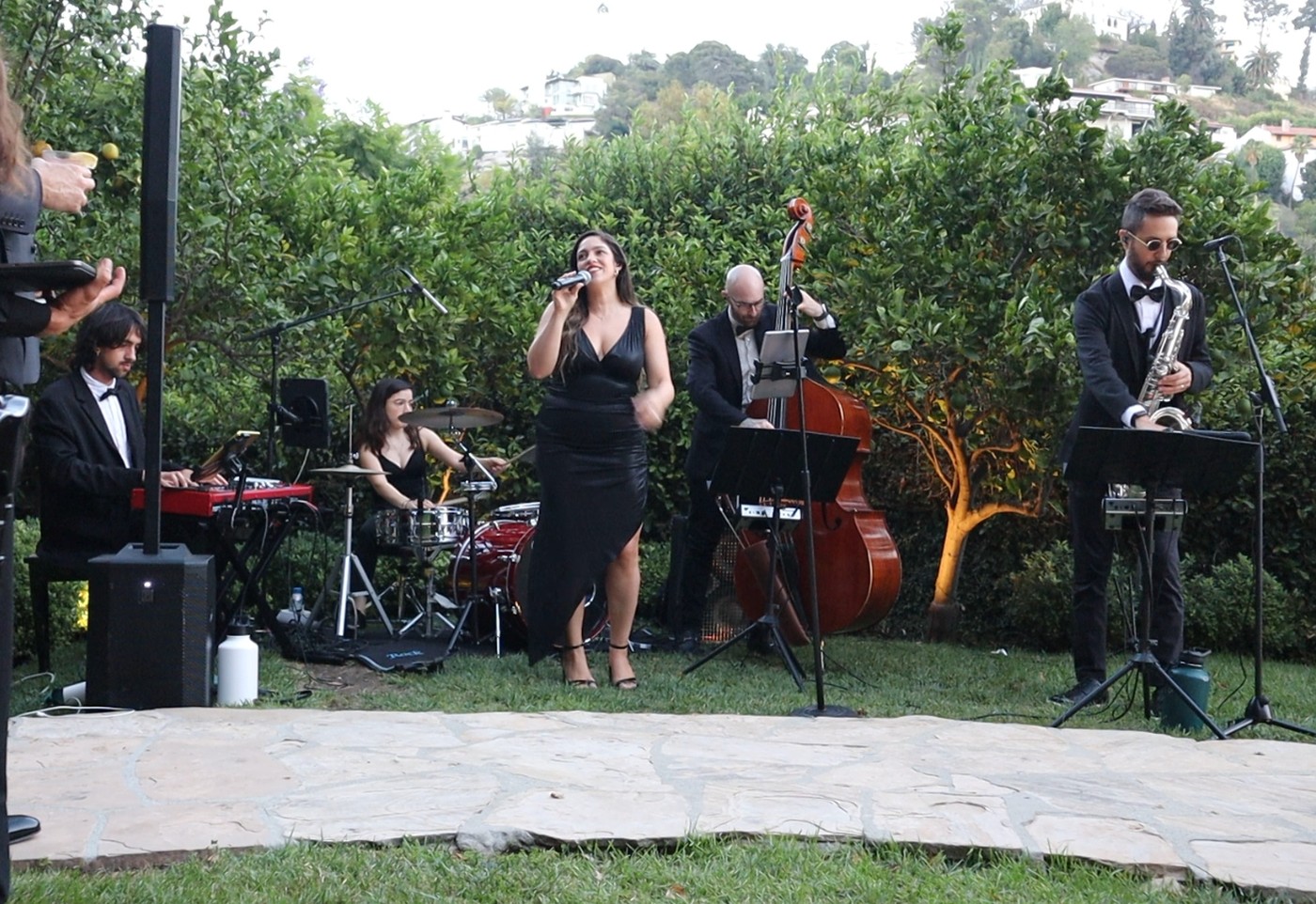
| Ranch or estate, outdoor | Space, a natural ceremony setting, flexible layout | Generator or house power, and the amplified sound cutoff | Residential neighbors and an early outdoor curfew |
| Warehouse or arts space | Load-in at grade, freedom of layout, late end times | Circuit count, breaker location and whether staging is rented | No built-in stage and hard reflective surfaces |
| Garden, museum or public grounds | Daylight ceremonies and a distinctive setting | Whether amplification is permitted at all outdoors | Institutional sound rules and early end times |
| Restaurant or private dining room | Intimacy and a short guest list | Usable floor space once tables are in | Room size caps the ensemble before budget does |
A live band is worth it at nearly every Los Angeles wedding venue, and the venues where it is not worth it are identifiable in advance from a short list of questions rather than discovered on the night.
The reason is that a room is a collaborator. A band playing into a hard, reverberant hall sounds different from the same band on a lawn, where sound simply leaves and never comes back. Rooms with some mass and some height flatter live instruments. Wide open outdoor spaces need more support from the PA to feel full, which in turn pushes against whatever sound limit the venue is working under. None of that is a reason to avoid live music. It is a reason to pick the ensemble and the setup for the room you chose rather than in the abstract.
The genuinely hard cases are narrow. A venue that prohibits amplification outdoors entirely, a room with a strict early cutoff and a ceremony that starts late, or a floor plan with no usable space once dinner tables are set. Each of those is answerable with an email before you put down a deposit, and in most of them the right move is not to drop live music but to change its shape: an unamplified string ensemble for the ceremony, a smaller group through dinner, and the full band once the room and the clock allow it.
How that decision compares against the alternative is covered in our guide to DJ vs live band for a wedding, and the full sequence of choices is set out in how to choose wedding entertainment in Los Angeles.
Because the law, not the venue, sets the clock. The Los Angeles Municipal Code splits the day into a daytime period and a nighttime period, and the dividing line is 10:00 p.m. Section 111.03 of the code applies daytime noise levels from 7:00 a.m. to 10:00 p.m. and nighttime levels from 10:00 p.m. to 7:00 a.m. When a venue inside the City of Los Angeles tells you outdoor music ends at ten, it is usually quoting that boundary back to you.
The levels themselves are zoned. Under the same section the code sets presumed ambient noise levels of 50 dB(A) day and 40 dB(A) night in residential zones, 60 day and 55 night in commercial zones, 65 in lighter industrial zones and 70 in heavy industrial zones. That spread is the real explanation for why a downtown warehouse can run late and a ranch with houses over the ridge cannot. The venue is not being difficult. It is sitting in a different zone.
Amplified sound has its own section. Los Angeles Municipal Code section 115.02 governs sound amplifying equipment and restricts noncommercial amplified sound outside residential zones between 10:00 p.m. and 7:00 a.m., with tighter rules inside residential zones. Again, ten o'clock.
The critical caveat is jurisdiction. Malibu, Culver City, Beverly Hills, Santa Monica, Pasadena, West Hollywood and Universal City are not the City of Los Angeles. Each has its own code, its own permit process and its own enforcement posture, and unincorporated Los Angeles County is different again. So a rule you read about one venue tells you very little about another twenty minutes away. Ask the specific property, and see our guide to Los Angeles wedding venue noise restrictions for the rules city by city.
Some venues publish a cutoff directly, and the pattern to look for is an outdoor cap at 10:00 p.m. alongside a separate, much later indoor end time. If a venue has both an outdoor ceremony space and an indoor ballroom, the two halves of your night may be running on two different clocks.
One practical consequence. If your amplified music stops at ten, your last downbeat is not ten. Build backwards: a final set that ends at 9:55 p.m., a last dance placed inside it, and a strike that starts immediately. Couples who discover the cutoff in the final timeline meeting lose a whole set to it.
This is the single most useful question on the whole list, and the one couples are least often told to ask. Our own technical rider asks for four dedicated 20 amp circuits at the stage, reserved for sound and backline. Two qualifiers matter as much as the number: the circuits should be non GFI, and they should not be shared with lighting, kitchen equipment, HVAC or dimmers.
The reason those qualifiers exist is that the count alone is easy to satisfy on paper and still fail in the room. A venue can honestly answer "yes, four 20 amp circuits" while those outlets sit on the lighting loop behind a GFI breaker. That configuration meets the request as written, trips during the first dance when the uplighting cycles, and puts audible hum into the PA in the meantime. Relay all three parts of the spec every time: four dedicated 20 amp circuits, non GFI, off the lighting circuit.
Whether the band or the venue supplies the PA does not change the power ask. It changes who is responsible for the rest of the audio chain, which is a separate conversation worth having early with the venue and the entertainment agency in Los Angeles coordinating your acts.
Load-in is the part of the day nobody photographs and everybody pays for. A band with a full PA, backline and lighting is moving real weight, and the distance between the truck and the stage is the single biggest driver of how long that takes. Venues rarely publish this, so it has to be asked.
The honest summary is that load-in almost never stops a booking. It changes the call time, the crew size and occasionally the labor line on the quote. Knowing it early means the number you are given is the number you pay.
Footprint is driven by instrumentation, not by the guest count and not purely by how many musicians are on the contract. A drummer needs a fixed rectangle that does not compress. An upright bass needs height and a clear path in. A horn line needs lateral space so players are not pointing directly into each other's microphones. A keyboard player with two tiers takes more depth than a single board. Two ensembles with the same number of players can need noticeably different areas.
Because of that, we size the stage against the specific lineup for your date rather than publishing one number, and we would rather give you an exact requirement for your ensemble than have you plan around a generic figure that does not match what shows up. What you can do in advance is get the venue's own facts, which are fixed regardless of who plays.
Send the floor plan when you enquire. It removes most of the guesswork on both sides, and it is how the recommendation between a cocktail and ceremony ensemble and a full dance band for hire in Los Angeles is actually made.
Very few of them, which is the finding itself. We looked at what a sample of well known Los Angeles area wedding venues state publicly on their own sites, and almost none publish power, load-in or sound cap information. Capacity and room names are published. The operational detail that determines your entertainment plan is not. Everything below is taken from each venue's own published material or from public record, and it is here as an illustration of the shape of the market rather than as current policy. Confirm anything that affects your date directly with the venue, because published information goes out of date and none of this is a substitute for your contract.
| Venue | Area | What its own material states | What it does not publish |
|---|---|---|---|
| Vibiana, operated as Redbird | Vibiana | Downtown Los Angeles, 214 S Main Street | The former Cathedral of Saint Vibiana, opened in 1876 in a Baroque-inspired Italianate style, later converted to an event space. The property describes a Main Hall, five private dining rooms and a hidden garden, with capacity up to 800 guests. | Power, load-in and sound policy are not published |
| SmogShoppe | 2651 S La Cienega Blvd, in the Culver City arts district | Capacity of 100 to 150 for weddings and seated dinners and up to 250 guests for cocktail parties, a DJ-ready sound system, and solar panels the venue says generate over 100% of its annual electrical energy needs. | Amplified sound cutoff, circuit detail and load-in are not published |
| Calamigos Ranch | 327 Latigo Canyon Rd, Malibu | Multiple named indoor and outdoor spaces including the Redwood Room, the Oak Room, the Pavilion, the Birchwood Room, the Vineyards and the Calamigos Coast Club, with the Birchwood Room stated at up to 120 guests. | No music end time or curfew is stated on the wedding page |
Read that table as a method rather than a shortlist. The useful takeaway is that a venue publishing a clear sound policy is doing you a favor and is rarer than it should be. When a venue does not publish one, that is not a red flag. It just means the answer has to come by email, and it should come before the deposit rather than after.
Live music in Los Angeles runs roughly $3,450 to $13,600 locally across ensemble sizes. The ranges below are for Los Angeles County and reflect the date, the time and whether the package includes a sound system. Venue choice does not change these numbers directly, but it does change which size of group makes sense in the room, which is the practical way the venue affects your entertainment budget.
| Ensemble | Local range | Where it fits in a wedding |
|---|---|---|
| String quartet | $3,000 to $4,500 | Ceremony and arrivals, usually unamplified, which suits venues with tight sound rules |
| Trio, instrumental | $3,450 to $6,450 | Cocktail hour and dinner in smaller rooms |
| Quartet, instrumental | $4,250 to $7,250 | Dinner service and daytime receptions |
| Quartet with vocalist | $4,650 to $7,650 | Dinner into the first dance |
| 5 piece | $5,550 to $8,550 | Reception dancing in mid size venues |
| 6 piece | $6,450 to $9,560 | Full dance sets with horns |
| 7 piece | $7,350 to $10,570 | Larger ballrooms and higher guest counts |
| 8 piece | $8,250 to $11,580 | Ballroom programs in bigger rooms |
| 10 piece | $10,050 to $13,600 | Mainstage receptions, 400 guests and up |
| DJ hybrid add on | $2,250 flat | Covers band breaks and the late night set, and solves the gap at venues with a long night |
Two venue-driven costs sit outside those ranges and are worth putting in your budget now. Staging rental if the venue has no riser, and venue labor or overtime if load-in or strike falls outside the contracted window. Neither is large, and both are avoidable surprises rather than unavoidable ones. Cost by act type is broken down further in our guides to the wedding DJ in Los Angeles and the string quartet for hire in Los Angeles.
Copy this into the email you send the venue coordinator. Ten questions, one reply, and your entertainment plan stops being guesswork. Send it before the deposit, because every answer is easier to negotiate while you are still a prospect.
If you are working with a planner, this list belongs in their venue comparison sheet alongside capacity and catering. Our resource on entertainment for event planners in Los Angeles covers how the same questions get folded into a full sourcing process.
| Venue situation | What we would suggest | Why |
|---|---|---|
| Outdoor ceremony with no amplification allowed | String ensemble, unamplified | Carries a ceremony acoustically and sidesteps the restriction entirely |
| Early outdoor cutoff, later indoor end time | Band outdoors into the cap, then move the party inside | Uses both clocks instead of losing the evening to the earlier one |
| Small room, seated dinner, under 100 guests | Trio or quartet | Footprint fits once tables are set and the volume suits the space |
| Ballroom over 250 guests with a dance floor | 6 to 10 piece with horns | Larger rooms absorb sound, and a bigger group fills them without straining |
| Warehouse or arts space with hard surfaces | Smaller amplified group, more attention to PA placement | Reflective rooms build up quickly, so restraint reads as better sound |
| Long night with a late end time | Band plus DJ hybrid | Covers breaks and the late set without a second contract |
| No stage, no riser, no rental budget | Smaller ensemble on the floor | Fewer players means sightlines still work without elevation |
The pattern across that table is that the venue narrows the field before taste does, and that is a good thing. Most couples arrive with an idea of the sound they want and no framework for whether the room supports it. Working in the other direction, from the constraints to the ensemble, produces better nights and fewer compromises made under time pressure. The DJ and live band hybrid exists specifically for the last of these situations, where the room is available longer than any single act should play.
All eight are process failures rather than taste failures, which is the encouraging part. None require a bigger budget to avoid. They require the questions to be asked in the right order, which is also the argument for involving whoever is providing your music before the venue contract is signed rather than after.
If what you want specifically is a dedicated jazz group for a ceremony or cocktail hour rather than a multi act program, our sister brand Sunny Jazz Band covers that side in depth.
Sunny Entertainment casts bands, DJs, string ensembles and hybrid setups for weddings across Los Angeles County and the surrounding region. Because we are casting rather than selling one fixed act, the venue comes into the conversation first: the room, the floor plan, the sound rules and the load-in, and then the ensemble that fits them.
In practice that means we will ask for your floor plan, your timeline and the venue's own answers on power and sound before we recommend a size. If your venue has an early outdoor cutoff we will build the evening around it rather than discover it in the final meeting. If the room has no riser we will tell you that staging is a rental line before it turns up on an invoice. And if the honest answer is that a smaller group will sound better in your room than a larger one, that is the answer you will get.
Almost all of them do, and the real variables are the amplified sound end time, the power available at the stage and the load-in route rather than permission itself.
The Los Angeles Municipal Code applies daytime noise levels from 7:00 a.m. to 10:00 p.m. and nighttime levels from 10:00 p.m. to 7:00 a.m., so 10:00 p.m. is the boundary most City of Los Angeles venues quote.
Not automatically, because those are separate cities with their own noise codes and permit processes, so the cutoff has to be confirmed with the specific venue.
Our rider asks for four dedicated 20 amp circuits at the stage, non GFI and not shared with lighting, kitchen or HVAC, and the same spec applies across band sizes.
It depends on instrumentation rather than headcount, so send the floor plan with your enquiry and we will give you the exact footprint for the lineup we propose.
Local ranges run from about $3,450 for an instrumental trio to $13,600 for a 10 piece, with a string quartet at $3,000 to $4,500 and a DJ hybrid add on at a flat $2,250.
Yes, on the floor, though sightlines suffer as the group gets larger, so either rent a riser or choose a smaller ensemble for rooms without built-in staging.
Book the venue first, but ask the sound, power and load-in questions before the deposit, because those answers determine which ensembles are realistic in that room.
Indoor rooms often run later than outdoor spaces, so look for a venue that states a separate indoor end time and get it in writing, since outdoor amplified music in the City of Los Angeles usually ends by 10:00 p.m.
San Diego, Santa Barbara, Palm Springs, Ojai and south Orange County sit on a separate distance tier of roughly $3,968 to $15,415 across the same ensemble sizes.
Stay in tune with the latest from SUNNY