


Noam Wolf | Aug 10, 2026 | 9:09 PM
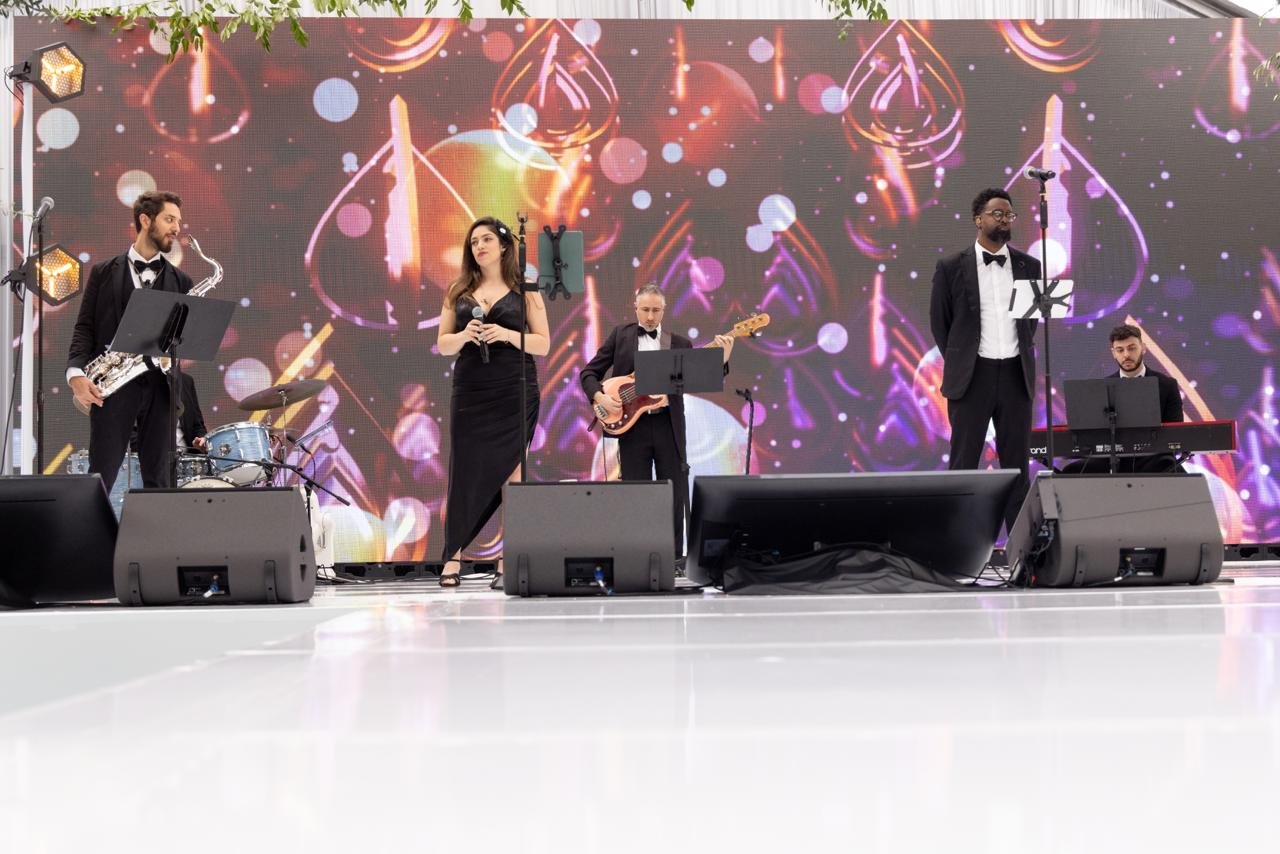
Specialty acts for events in Los Angeles are the entertainment pieces that sit outside the standard band-or-DJ choice: a solo violinist under string lights, an LED sax player cutting through a reception peak, a string quartet for a ceremony, a vinyl DJ for a brand activation. Planners book specialty acts for events when a room needs a moment that a four-hour dance set cannot deliver on its own.
| Specialty act | Best moment for it | Los Angeles cost |
|---|---|---|
| Solo instrumentalist (sax, violin, piano, cello) | Ceremony, cocktail hour, brand activation | Quoted per event |
| String quartet or string duo | Ceremony, cocktail hour, gala seating | $3,000 to $4,500 |
| Jazz trio or quartet | Cocktail hour, dinner service | $3,450 to $7,250 |
| Live musician over a DJ set | Reception peak, corporate after-party | $2,250 DJ hybrid add-on |
| LED sax or LED percussion | Reveal moments, late-night, product launches | Quoted per event |
| Electric violin feature act | Mainstage, activations, awards moments | Quoted per event |
| Vinyl DJ | Cocktail hour, fashion and brand events | Quoted per event |
| Full band, 5 to 10 pieces | Reception, gala, conference mainstage | $5,550 to $13,600 |
A specialty act is any performance element booked for a defined purpose rather than to cover the whole night. The category is broad in the events world and covers everything from strolling performers and aerialists to instrumentalists and cultural ensembles. On the music side, which is where a Los Angeles entertainment agency Los Angeles clients hire tends to concentrate, it usually means one of four things.
The first is a soloist or small ensemble covering a specific block, most often a ceremony or a cocktail hour. The second is a layered act, where a live player performs over a DJ set so the room gets a live focal point without losing the continuity of recorded music. The third is a visual act, where the instrument itself is the spectacle, such as LED sax or LED percussion. The fourth is a cultural or language-specific ensemble booked because the guest list calls for it.
The distinction matters for budgeting. A specialty act is priced against the block it covers, not against the length of the event, so a 45-minute ceremony ensemble and a four-hour reception band are not comparable line items. Planners who treat them as interchangeable usually end up either overspending on coverage they do not need or leaving a dead room during dinner.
Yes. Specialty acts do a job that a single headline act cannot, which is to change the temperature of a room at a specific moment. A reception band is optimized for a packed dance floor. It is not optimized for a processional, a plated dinner where guests need to talk, or the sixty seconds when a product comes out from behind a curtain.
The practical argument is that specialty acts are usually the cheapest way to raise the perceived production value of an event. Adding a live sax player over an existing DJ set costs a fraction of upgrading from a five-piece to a ten-piece band, but it is the thing guests film and post. For corporate clients, that is often the entire point of the spend.
The honest counter-argument is that specialty acts can be a poor buy when they are bolted on without a role. Booking a string quartet for a ceremony that is eight minutes long, or an LED act for a room with the house lights up, spends money on something nobody registers. The test is simple: name the exact moment the act exists to serve. If you cannot name it, cut it and put the money into the block that carries the most hours.
Los Angeles pricing depends on the size of the act, the length of the block and whether sound is included. The ranges below are local rates, meaning Los Angeles County and roughly a 50-mile radius. Events in San Diego, Santa Barbara, Palm Springs and south Orange County are quoted separately because travel and crew change the math.
| Package | Los Angeles range | Typical use |
|---|---|---|
| String quartet | $3,000 to $4,500 | Ceremony and cocktail hour |
| Trio (instrumental) | $3,450 to $6,450 | Cocktail hour, dinner |
| Quartet (instrumental) | $4,250 to $7,250 | Cocktail hour, dinner |
| Quartet with vocalist | $4,650 to $7,650 | Dinner into early dancing |
| 5-piece band | $5,550 to $8,550 | Reception, corporate program |
| 6-piece band | $6,450 to $9,560 | Reception, gala |
| 8-piece band | $8,250 to $11,580 | Gala, conference mainstage |
| 10-piece band | $10,050 to $13,600 | Large gala, big-band programming |
| DJ hybrid add-on | $2,250 | Live player layered over a DJ set |
Two notes on reading that table. String players usually perform unamplified, and the quartet rate can cover a small sound system if the space needs it, so cocktail-hour-only bookings sit at the flexible end while a ceremony plus cocktail hour (two separate sections) costs more than the published range. And the DJ hybrid figure is a flat add-on to a DJ and live band hybrid booking rather than a standalone price.
Acts listed as quoted per event are genuinely case by case. LED instruments, feature acts and vinyl DJs vary with set length, the number of players and what the venue can support, and quoting a single number for them would be misleading. Date matters too: a Saturday in October prices differently from a Thursday in February.
Mapping acts to blocks is the part most planners get wrong, so it is worth walking the timeline in order. For a ceremony, the requirement is clarity and volume control, which favors strings or a solo instrumentalist. Amplification is often unnecessary outdoors at small guest counts and becomes necessary the moment the space opens up or the wind picks up.
Cocktail hour is the most forgiving block and the one where a specialty act earns the most. Guests are standing, talking and moving, so the music has to sit under conversation while still registering as live. A jazz trio, a string duo or a solo instrumentalist all work here, and this is the natural home for cocktail and ceremony music decisions.
Dinner needs the volume to come down again without the room going flat. A trio or a quartet with vocals handles this well. The reception peak is where a full band or a dance band for hire in Los Angeles takes over, and it is also where a layered live player over a DJ set does its best work, because the DJ holds continuity while the live player supplies the visual.
Late-night and after-party blocks reward the visual acts. This is where LED sax and LED percussion belong, when the house lights are down and the act reads as part of the lighting design rather than competing with it. For corporate programs, the reveal moment (a product, an award, a keynote entrance) is a separate consideration and usually the single highest-value place to spend on a specialty act.
Work through these five questions in order. They are sequenced so that the answers narrow the field rather than reopening it, which is what keeps a specialty booking from turning into a budget leak.
If the event is a wedding and you are still deciding the overall shape of the entertainment before drilling into specialty pieces, start with how to choose wedding entertainment and come back to this page once the main act is settled.
Take a 220-guest nonprofit gala at a venue like The Ebell of Los Angeles in Hancock Park. The program runs a 6pm reception in the courtyard, a seated dinner with a live auction in the main dining room, and dancing in the ballroom from 9pm. Three different rooms, three different jobs, one budget.
A workable build is a string quartet in the courtyard for the reception, a jazz trio at low volume through dinner so the auctioneer can be heard between lots, and a six-piece band for the ballroom. The specialty layer is the courtyard quartet, which sets the tone before a single speech happens and costs a fraction of extending the band's call time to cover the earlier block.
The alternative build, for a client who wants the money concentrated at the back of the night, is a DJ through reception and dinner with a live sax player layered in for the final hour. That version trades the courtyard atmosphere for a bigger finish, and it is usually the cheaper of the two. Both are legitimate; the choice depends on whether the event is judged on how it opened or how it ended.
Corporate programs follow the same logic with different labels, and the sourcing considerations for those are covered in more detail on corporate event entertainment agency.
Start earlier than feels necessary. Specialty players in Los Angeles are working musicians with their own calendars, and the strongest ones are committed 3 to 6 months out for peak dates. A Saturday in October is a different market from a Tuesday in February, and the gap widens every year.
Book the specialty act and the main act through the same agency where you can. One contract means one point of contact for the timeline, one certificate of insurance for the venue, one load-in schedule, and one party responsible when a player has a conflict. Sourcing a quartet from one place and a DJ from another is how planners end up mediating between two vendors on the day.
Ask for unedited footage rather than a cut reel. A reel proves the act can be edited well; a single continuous take proves they can play. Ask specifically for footage from a room the same size as yours, because an act that fills a 400-person ballroom can overwhelm a 60-person dinner.
Finally, confirm what is included in the quoted number: sound, lighting, travel, and how many sections the price covers. Sound in particular is the line item that most often turns a comparison between two quotes into an apples-to-oranges exercise. If you are comparing a DJ-led build against a live build, event DJ Los Angeles and DJ vs live band both break that comparison down.
Specialty acts for events are the most efficient way to buy a moment rather than an evening. Book them against a named block, check the room before you fall in love with an act, and price them by section rather than by hour. A string quartet at $3,000 to $4,500 or a $2,250 live-over-DJ layer will often do more for how an event is remembered than the same money spent scaling a band up one size.
For a dedicated jazz band rather than a specialty layer, see sunnyjazz.band. For everything else, one conversation covers the whole build.
A live musician layered over a DJ set, usually sax or percussion. It is the most requested because it gives a room a live focal point without giving up the continuity of a DJ, and the $2,250 add-on is small relative to what it changes about the night.
Plan on $3,000 to $4,500 depending on date and time. Strings usually perform unamplified and that rate can cover a small sound system if the space needs one. A ceremony plus cocktail hour counts as two sections and prices above the range. Full details are on string quartet for hire in Los Angeles.
For a short event, yes. A cocktail reception of two hours or a ceremony-only booking can be covered by a quartet or a soloist alone. For a full reception with dancing, a specialty act is a layer rather than a replacement, because no soloist is built to hold a dance floor for four hours.
Three to six months for peak season in Los Angeles, which is May, June, September, October and December. Off-peak dates can often be booked inside 8 weeks, though the choice of specific players narrows.
It depends on the act and the room. Strings often play unamplified at smaller guest counts. Anything outdoors, anything over roughly 100 guests, and anything sharing a space with speeches will generally need amplification, which is why sound should be confirmed in writing as included or excluded before you compare two quotes.
Usually, yes. Requests for a vinyl DJ, a larger horn section, a language-specific ensemble or a custom lineup are handled as a custom proposal rather than an off-the-shelf package. Tell us the moment you are trying to create and the build comes back with it.
Stay in tune with the latest from SUNNY