


Noam Wolf | Sep 14, 2026 | 2:49 PM
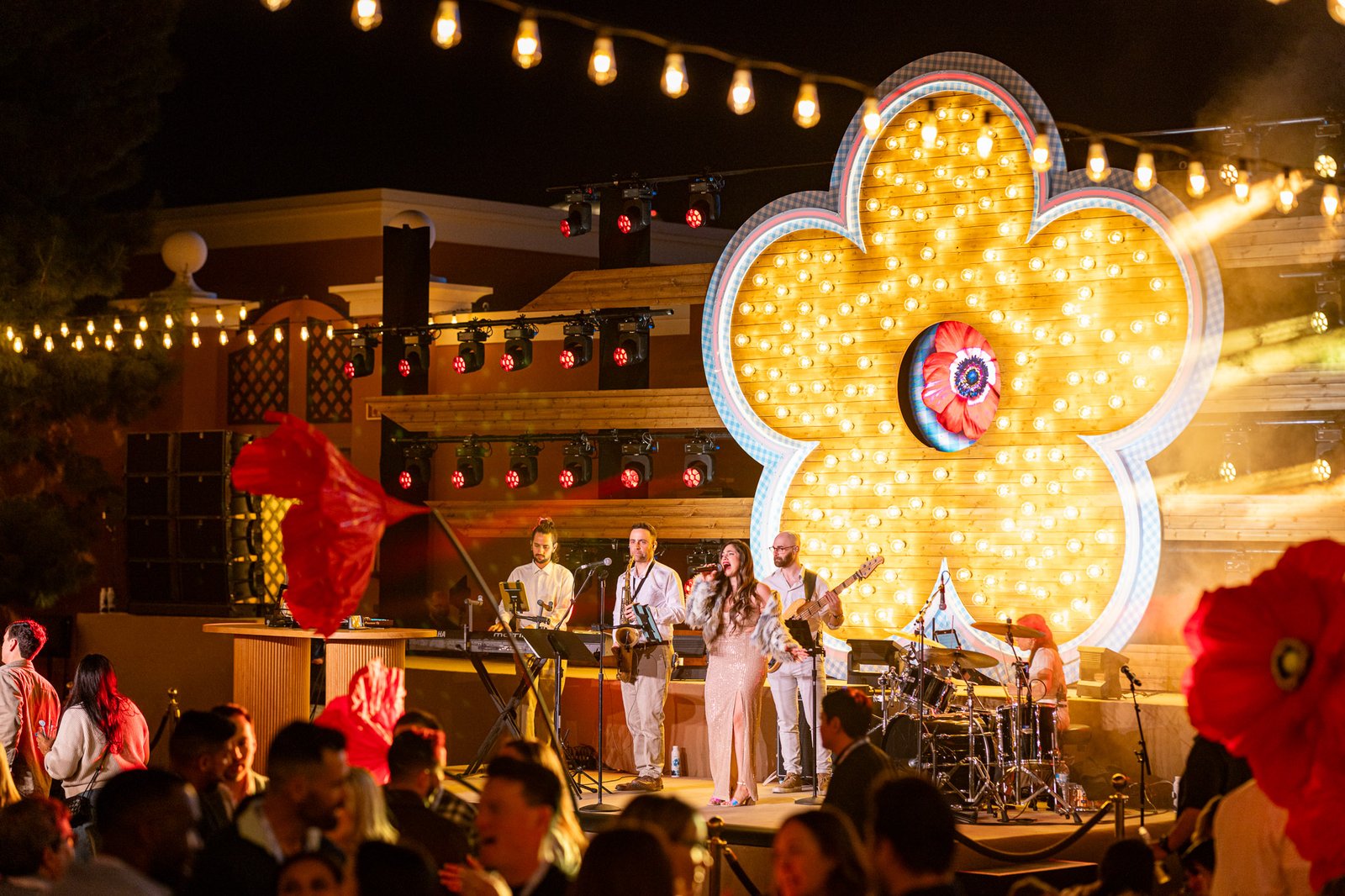
A tribute band for corporate event entertainment gives a company party something a general dance band cannot: a headline the room already recognizes before the first downbeat. This guide covers when a tribute or themed act is the right call for a corporate event in Los Angeles, how to vet one, what it costs, and the three places themed entertainment quietly goes wrong.
| Format | What the Room Gets | Best Corporate Fit | Budget Starting Point |
|---|---|---|---|
| Single-artist tribute | One catalog, start to finish, with matching look and staging | Milestone anniversary, holiday party with a strong shared reference | Band tier plus a themed production line, quoted per event |
| Era or decade themed band | A decade of hits across many artists, styled to match | Company party with a wide age range, client appreciation night | 5-piece $5,550 to $8,550, 8-piece $8,250 to $11,580 |
| Themed band plus DJ | Live themed sets, DJ covers the gaps and the late night | Large parties, after-parties, mixed music taste | Band tier plus a flat $2,250 DJ hybrid add-on |
| Specialty or visual act | A short high-impact feature rather than a full night of music | Product launch, brand activation, reception moment | Quoted per event |
| Standard dance band, no theme | Broad crowd-pleasing set list, no wardrobe concept | Any corporate party where the theme is not the point | $3,450 to $13,600 by lineup size |
A tribute band commits to one artist. The set list comes from that artist's catalog, the arrangements follow the recordings closely, and the wardrobe, instruments and stage look are chosen to match a specific period of that artist's career. The promise to the audience is fidelity. When it lands, people sing every word, because they already know every word.
A themed band is broader. It is built around an era, a genre or a mood rather than one performer: a seventies dance night, a Motown-era soul set, an eighties party, a big band and swing evening. The band plays many artists inside that frame, and the styling supports the frame rather than impersonating anyone. The promise is atmosphere, not fidelity.
The practical difference for a corporate buyer is flexibility. A tribute act is fixed by definition. If half your room does not know the artist, there is no recovery inside the set. A themed band can widen or narrow the repertoire on the night, drop a decade that is not connecting and pull in a broader crowd-pleaser, because nothing in its identity depends on staying inside one catalog. For most corporate audiences, which are wide by age and by taste, the themed format is the safer buy and the tribute format is the higher ceiling.
There is also a sourcing difference that matters more than most planners expect. A tribute act is usually a fixed unit that exists independently and gets booked as-is. A themed band is more often cast for the event, which is how an entertainment agency in Los Angeles normally handles it: the core rhythm section stays, and horns, strings, extra vocalists or a specialty feature are added to fit the concept and the budget. That is why themed pricing is quoted rather than listed.
Yes. A tribute or themed band is right for a corporate event when the party is the point and the room shares a reference. That combination is more specific than it sounds, and it is worth testing before you commit budget to it.
It works when the evening is social rather than programmatic. Holiday parties, anniversaries, appreciation nights and after-parties all have long stretches where the only job is to keep people in the room and on their feet. A theme gives those stretches a shape. It also gives the event an identity that survives the invitation, the signage, the photo backdrop and the recap email, which is real value that a generic band does not deliver.
It works less well when the night has content to deliver. If there is an awards presentation, an executive address, a product reveal or a fundraising ask, the entertainment has to yield to the program, and a costumed tribute act sitting through forty minutes of speeches is an expensive way to fill a stage. In those cases the better structure is a smaller ensemble for the front half and the themed show after the program closes.
It fails outright when the theme is a personal favorite rather than a shared one. The test is simple and unglamorous: name the three most common age bands in the company, and ask whether all three would recognize the first five songs. If two out of three would not, the theme is wrong even if the act is excellent. This is the single most common cause of an expensive, quiet dance floor.
One more filter: the venue. Themed shows tend to bring more gear, more wardrobe and more staging than a standard band, so a venue with a tight load-in, a low ceiling or a hard curfew can quietly cut the show down to something that no longer justifies the premium. Confirm the physical constraints before you fall in love with the concept.
Not every corporate event benefits equally. Here is how the common formats sort across our corporate event entertainment work, based on how much of the evening is unstructured social time and how much is program:
This is the real decision, and it is not the same as the band versus DJ question. Both options here are live bands. The question is whether you pay a premium for a concept.
| Consideration | Tribute or Themed Band | General Dance Band |
|---|---|---|
| Pre-event marketing value | High. The theme is the invitation and the signage. | Low. Guests learn about the music on the night. |
| Repertoire flexibility on the night | Limited for a tribute, moderate for an era theme. | High. The band reads the room and adjusts. |
| Risk if the room does not connect | High. There is no second gear inside the concept. | Low. The set list can move across decades. |
| Photo and content output | Strong. Wardrobe and staging carry the recap deck. | Adequate. Depends on the venue and lighting. |
| Lead time to book | Longer. The show is cast and rehearsed. | Shorter. The lineup already plays together. |
| Cost | Band tier plus a production premium, quoted per event. | Published lineup pricing, $3,450 to $13,600 local. |
| Repeat-year value | Diminishing. The same theme lands softer twice. | Stable. The same band can play a different set. |
The honest read: a themed show is worth the premium when the event has a reason to be memorable this specific year, and it is not worth it when the party is an annual habit. Companies that book a theme every year tend to see the effect decay, because the novelty was doing most of the work. A useful pattern is to alternate, using a dance band for hire in Los Angeles for ordinary years and reserving the themed production for milestones.
If you are still deciding between live music and a DJ at all, that is a different comparison with different economics, and the DJ and live band hybrid in Los Angeles format often resolves it without forcing a choice.
Think of the cost in two layers, because that is how it is actually built and quoted. Layer one is the music: a working band of a given size, with sound. Layer two is the theme: wardrobe, extra rehearsal for a fixed repertoire, any added players the concept requires, and any staging or lighting the look depends on.
Layer one has published Los Angeles ranges. These are local rates, meaning Los Angeles County or roughly fifty miles, and they include sound at the upper end of each range:
| Lineup | Los Angeles Range | Typical Themed Use |
|---|---|---|
| Trio | $3,450 to $6,450 | Cocktail or reception set inside a themed evening |
| Quartet | $4,250 to $7,250 | Small themed set, tight stage or low ceiling |
| Quartet with vocalist | $4,650 to $7,650 | Entry point for a vocal-led era theme |
| 5-piece | $5,550 to $8,550 | The common floor for a themed dance set |
| 6-piece | $6,450 to $9,560 | Era theme with a horn or an extra vocalist |
| 8-piece | $8,250 to $11,580 | Full themed show with a horn section |
| 10-piece | $10,050 to $13,600 | Big band or swing era, full production |
| DJ hybrid add-on | $2,250 flat | Covers set breaks and the late-night block |
Layer two does not have a published rate, and we will not print one, because inventing a themed premium would mislead you. The variables that drive it are genuinely event-specific: how many additional players the concept needs, how much dedicated rehearsal a fixed set list requires, whether wardrobe is being sourced or already exists, and whether the look depends on staging and lighting that someone has to build. Two themed shows at the same lineup size can differ substantially on those four inputs alone. So the themed layer is quoted per event, on the actual concept, and the band tiers above are the reliable part of the estimate.
Two things that reliably move the number and are easy to forget. First, distance. The ranges above are local. San Diego, Santa Barbara, Palm Springs, Ojai and south Orange County price on a separate distance tier, roughly $3,968 to $15,415 across the same lineup sizes. Second, the program. If the themed act has to hold the stage across a long speaking block, you are paying a full band to wait, and a smaller ensemble for that stretch is usually the cheaper and better answer.
Vetting a themed act is not the same as vetting a party band, because the failure modes are different. A general band fails by being boring. A themed act fails by being thin: the costume is right and the music is not, or the music is right and the show looks like a rehearsal. Ask for evidence on both halves.
This section is not legal advice, and a themed corporate event is a reasonable place to involve your own counsel. But there are two practical points worth knowing before you approve artwork.
The first is naming and imagery. A tribute act's name and likeness sit close to another artist's brand, and how close is a judgment call the act has made, not one you have. Before that name goes on your invitation, your signage, your intranet or a sponsor-facing deck, have someone at your company look at it the way they would look at any other third-party mark appearing in your materials. The safe version, and the one many corporate clients land on, is to describe the evening by era or genre in your own materials and let the act be the act on the night.
The second is performance licensing. Live cover performance at a venue is normally covered by the venue's own performing-rights licenses, which is why this rarely surfaces for a hotel or event space. Performing-rights organizations license the businesses where the music is performed, and ASCAP lists hotels, music venues, convention and trade shows, restaurants and bars among its licensees. It can surface when the event is somewhere unusual, such as your own office, a private property or a space that does not host live music routinely. Ask the venue whether it holds current licenses. If the answer is no or unclear, raise it early rather than the week of the event.
A third point applies if you are recording. Streaming a themed show internally, cutting it into a recap video or posting it on a company channel is a different use than performing it live, and it can require permissions the live performance does not. US copyright law treats the right to reproduce a work as separate from the right to perform it publicly, and ASCAP states that it does not license the right to record music or to include it in an audio-visual work, which are rights licensed by the writers or publishers. Decide whether you are filming before you sign, and put the answer in the agreement.
A themed act needs a tighter brief than a standard band, because it has fewer improvisational escape routes. Give it these six things and most of the risk disappears:
If you are a planner assembling this for a client rather than for your own company, the full brief structure and the paperwork checklist live in entertainment for event planners in Los Angeles.
The following is an illustrative build, not a past event. It shows how a themed program is normally structured across a single evening so you can price and staff against something concrete.
| Block | What Plays | Why |
|---|---|---|
| Arrivals and cocktails, 60 min | Small ensemble, styled to the theme but not the full show | Sets the period immediately without spending the headline before the room is full |
| Dinner, 60 to 75 min | Same ensemble, lower volume, or curated playback | Conversation has to be possible; this is not the moment for the production |
| Program, 20 to 30 min | Nothing live. Mics belong to the speakers. | The one block where entertainment must yield completely |
| Themed show, first set, 45 min | Full band in wardrobe, strongest recognizable material first | The room is fed, seated and warm; this is peak attention |
| Break, 20 min | DJ or playback in period | Keeps energy up without asking a costumed band to vamp |
| Themed show, second set, 45 min | Dance-floor material, broader if the first set read narrow | Where the fallback plan earns its keep |
| Late night, 30 to 45 min | DJ | Cheaper than extending a full band and better suited to a thinning room |
Read against the pricing table above, a build like this is typically an 8-piece or 10-piece band for the show blocks, a smaller ensemble drawn from the same players for arrivals and dinner, and a DJ hybrid for breaks and late night, plus the quoted themed layer. That structure is also why a themed evening is usually sourced through one vendor rather than three: the small ensemble and the full band should be the same musicians, and the changeovers should be somebody else's problem. The reasoning behind single-vendor sourcing for company events is covered in the corporate event entertainment agency in Los Angeles guide.
In our experience, three failures account for many of the disappointing themed nights, and all three are decided in advance rather than on the night.
The theme was chosen by one person. A theme picked by the CEO, the founder or the planner is a theme picked for one taste. It shows up as a full dance floor for twenty minutes and an empty one for the next hour. The fix costs nothing: run the concept past a handful of employees across different tenure and age bands before you book, and listen to the flat responses rather than explaining past them.
The theme was bought instead of built. Costume without musicianship is the most expensive way to underwhelm a room, and it is the most common thing sold under the word tribute. The signal is footage: an act with a real themed show has real video of it. An act that only has stills and a description has a concept, and you are paying to develop it.
The show fought the program. A themed act that is loud and visual is competing with your speakers, your video content and your announcements unless somebody has decided in advance who wins each block. This is the failure that makes executives skeptical of live music generally, and it is entirely a run-of-show problem, not a talent problem.
A quieter fourth: booking too late. Themed shows are cast and rehearsed, so a short timeline compresses the part of the process that makes the theme convincing. If you are inside ninety days of a Q4 date, a strong general band with a themed dress code and themed decor will usually outperform a rushed tribute production, at a lower price.
Sunny Entertainment casts themed and tribute-style corporate programs rather than selling a fixed shelf act. In practice that means the core band, any added horns, strings or vocalists, the smaller ensemble for arrivals and dinner, and the DJ for breaks and late night are sourced and coordinated together, against your run of show and your budget. If what you actually want is a straight jazz band rather than a themed production, sunnyjazz.band is the dedicated jazz side of the same operation.
Book a tribute band for a corporate event when the night is social, the room shares a reference, and the year is worth marking. Book an era or decade themed band instead when the audience is wide, which for most companies it is. Book a straight dance band when the party is an annual habit and the theme would be decoration rather than a reason.
Budget in two layers: the published Los Angeles band ranges of $3,450 to $13,600 by lineup size, plus a themed production layer that is quoted per event because wardrobe, rehearsal, added players and staging genuinely differ show to show. Add $2,250 for a DJ hybrid if you want the breaks and the late night covered. Then spend your attention on the two things that actually decide the night: whether the theme fits the room, and whether the run of show tells everyone who owns each block.
The live music underneath the show follows standard Los Angeles band pricing, from $3,450 for a trio to $13,600 for a 10-piece, local rates with sound. The themed layer on top, meaning wardrobe, extra rehearsal, added players and staging, is quoted per event because those inputs vary widely between concepts. Ask for the two layers separately so you can see which one you are able to flex.
For most holiday parties, an era or decade themed band is the safer choice. Holiday parties draw the widest internal audience of any corporate event, and a single-artist tribute only works if that artist is genuinely shared across the whole room. A decade theme delivers most of the atmosphere with far more room to adjust on the night.
Give it 6 to 12 months for a Q4 or holiday-season date in Los Angeles, and 4 months minimum otherwise. Themed shows need longer than standard bands because the lineup is cast and the set is rehearsed. Inside 90 days, a strong general band with themed decor and a dress code usually gives a better result than a rushed production.
A 5-piece at $5,550 to $8,550 is the practical floor for a themed dance set. Most era themes read better at 6 to 8 pieces because horns and extra vocals are what make a period sound convincing, and a big band or swing concept generally needs a 10-piece at $10,050 to $13,600. Room size and ceiling height can cap this regardless of budget.
Yes, and it is usually the more efficient build. A smaller ensemble drawn from the same players covers arrivals and dinner in a lighter version of the theme, then the full show takes the stage after the program. That keeps one vendor across the whole evening and avoids paying a full production to sit through dinner service.
Usually yes, for two specific jobs: covering set breaks, which a costumed band cannot busk through, and running the late-night block after the band finishes. The DJ hybrid add-on is a flat $2,250 in Los Angeles, which is materially cheaper than extending a full band for the same stretch. If you want the DJ to carry more of the night than that, see event DJ Los Angeles for how a standalone booking is priced.
This is not legal advice, but two things are worth checking. First, an act's name and imagery sit close to another artist's brand, so have your own team review it before it appears on company materials. Second, live cover performance is normally covered by the venue's performing-rights licenses, which can be a gap at an office or private property. Filming or streaming the show is a separate question again, so decide before you sign.
Ask that question before you book, not during the party. A well-prepared act has a broader second set already rehearsed and can widen the repertoire without breaking the evening. Get the fallback described in the agreement. If a vendor cannot describe one, treat that as the answer.
Yes. San Diego, Santa Barbara, Palm Springs, Ojai and south Orange County price on a separate distance tier, roughly $3,968 to $15,415 across the same lineup sizes. The themed layer is quoted per event either way. Confirm which tier your venue falls into early, because it can move the total by a few thousand dollars.
Stay in tune with the latest from SUNNY