


Noam Wolf | Sep 17, 2026 | 5:19 PM
An MC for corporate event programs in Los Angeles does far more than read names off a card. The MC is the only person who touches every minute of your run of show, and a good one is the difference between a program that moves and a room that drifts. This guide covers what the role actually is, who should fill it, what drives the cost, and how to brief one so the night runs on time.
| Who hosts | Best for | What it costs | Main risk |
|---|---|---|---|
| Professional emcee | Awards programs, conferences, anything with a fixed script and sponsors | Quoted per event | Generic delivery if they are briefed late |
| Bandleader as host | Holiday parties, anniversaries, receptions where music leads the night | Usually included in the band engagement | Limited scripting and no coverage while the band is off |
| DJ as host | Parties and mixers with light announcements and a dance floor | Usually included in the DJ engagement | Announcement style rather than program hosting |
| Internal executive | Intimate team dinners, internal culture moments | No cost | They are a guest too, and the clock slips |
| Broadcast or celebrity host | Flagship brand moments with press in the room | Quoted per event | Long lead time and a separate approvals cycle |
Yes. As a practical rule we use when planning corporate programs, once a run of show carries more than about three scheduled moments, we recommend a dedicated MC, because the role pays for itself in recovered time and in the parts of the night your guests actually remember.
The reason is structural rather than theatrical. A corporate program is a series of handoffs: doors to dinner, dinner to the speaking block, speaking to awards, awards to music, music to close. Every handoff is a place where a room can go quiet, a speaker can wander, or twenty people can decide it is a good moment to go outside. An MC is the person whose only assignment is to make those handoffs land, which is why the good ones sound effortless and the absence of one is so obvious.
Where you can skip it: a cocktail reception with no speaking, a team dinner under about fifty people, or a party where the whole point is that nobody stands at a microphone. In those rooms a host is overhead. The moment you add an award, a sponsor thank you or a CEO address, the calculation flips.
How the hosting role fits into sourcing the rest of the program is covered in our guide to working with a corporate event entertainment agency.
That second to last item is the one that separates a professional from a confident volunteer. Anyone can read an introduction. Deciding on your feet which two minutes to cut, and doing it without the audience sensing the edit, is a learned skill.
Most corporate programs in Los Angeles are hosted by one of four people, and the right answer is driven by how much script the night carries rather than by budget.
A professional emcee is the right call when the program has a fixed running order, named honorees, sponsor obligations or press in the room. They rehearse, they hold time, and they are accountable to the run of show rather than to the mood of the evening.
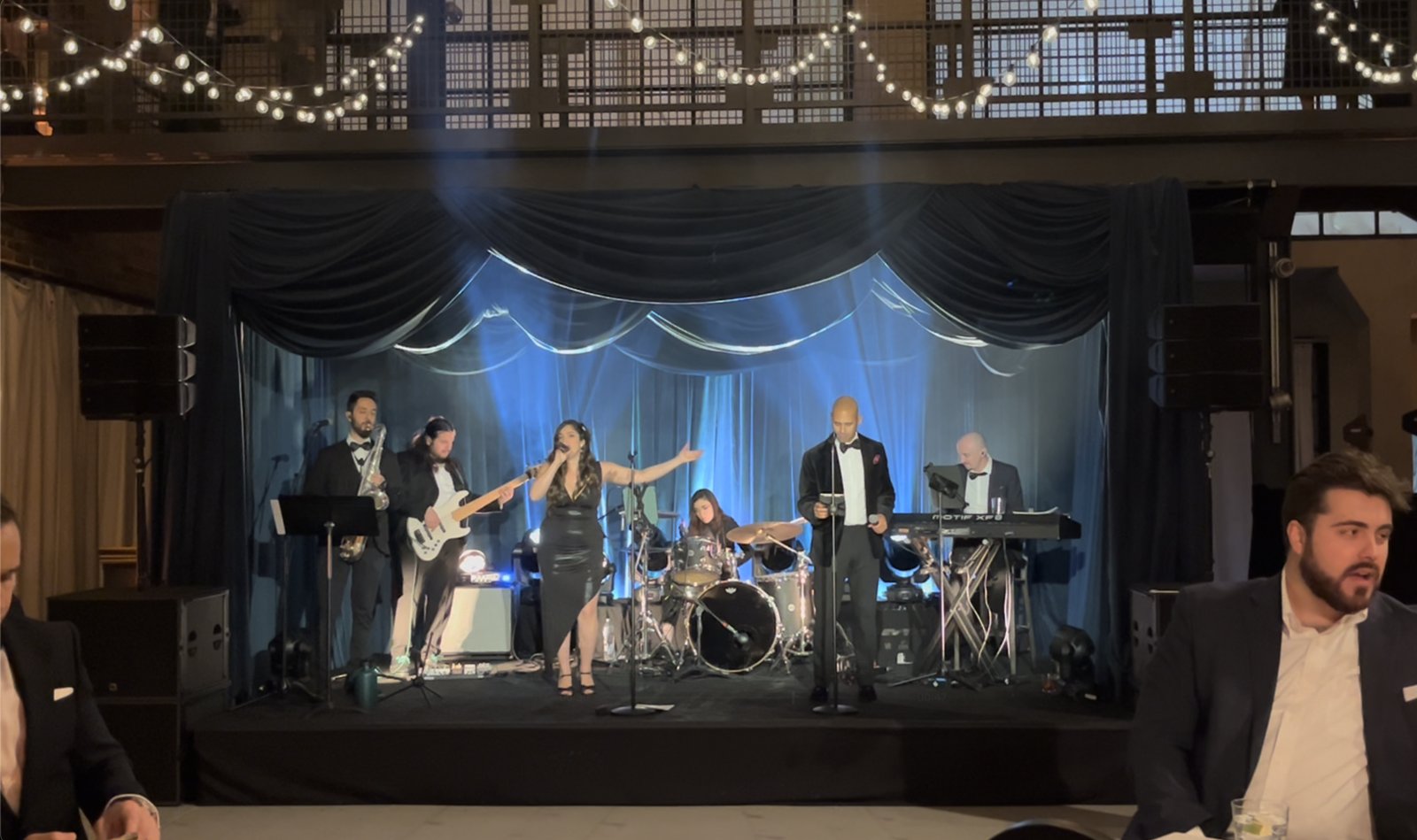
A bandleader is the most underrated option for a music led night. If the evening is a holiday party or an anniversary where the band is on for most of the night, the bandleader is already at a microphone, already reading the room, and already cueing the next moment. What a bandleader will not do is host the forty minutes before the band starts, so the coverage gap has to be solved separately.
A DJ handles announcements well and hosting moderately. The distinction matters: announcing that dinner is served is not the same job as introducing a chief executive. For a party with a dance floor and light structure, a DJ hosting is usually enough. Scope for the event DJ in Los Angeles is covered separately, including what announcement duties normally come included.
An internal executive is free, knows the names, and is genuinely the right choice for small internal moments. The failure mode is predictable: they are also a guest, they are pulled into three conversations between blocks, and the program slides. If you go this route, give them a printed run of show and a second person on a clock.
Emcees and hosts are quoted per event. There is no honest published range, because a two hour awards dinner with a scripted running order and a rehearsal is a different product from an hour of light announcements at a mixer, and giving you an average would only mislead the budget you build from it. What follows is what actually moves the number, and the music costs you can commit to today.
| Program element | Local range | Notes |
|---|---|---|
| Emcee or host | Quoted per event | Driven by hours, scripting and rehearsal |
| String quartet | $3,000 to $4,500 | Arrivals and registration, usually unamplified |
| Trio, instrumental | $3,450 to $6,450 | Reception and dinner under a speaking program |
| Quartet, instrumental | $4,250 to $7,250 | Dinner service, daytime programs |
| Quartet with vocalist | $4,650 to $7,650 | Dinner into an awards block |
| 5 piece | $5,550 to $8,550 | Reception dancing, mid size parties |
| 6 piece | $6,450 to $9,560 | Full dance sets with horns |
| 8 piece | $8,250 to $11,580 | Ballroom programs, larger rooms |
| 10 piece | $10,050 to $13,600 | Mainstage, 400 guests and up |
| DJ hybrid add on | $2,250 flat | Added to any band to cover breaks and late night |
For a working planning figure, a typical Los Angeles awards dinner with a string quartet at arrivals, a trio through dinner and a 6 piece band for dancing sits in the region of $12,900 to $20,510 for the music alone, before the emcee and before any specialty moment. That is an arithmetic sum of the published ranges above to set a client expectation, not a quote. Cost by act type is broken down further in our guides to conference entertainment in Los Angeles and specialty acts for events.
The same decision applied to the entertainment program as a whole is set out in our resource for entertainment for event planners.
An MC briefed a week out with the fields below will hold your program. An MC handed a timeline in the green room forty minutes before doors will improvise, and improvisation is exactly what you are paying to avoid.
| Field | Why the MC needs it | What happens if you skip it |
|---|---|---|
| Run of show with real clock times | Lets them pace the night against a schedule rather than a feeling | The program drifts and the hard stop arrives early |
| Names, titles and phonetic pronunciations | An introduction is the one line that cannot be wrong | A senior name mispronounced on a live microphone |
| Who approves changes on the night | Someone must be able to say cut two minutes, with authority | Three people give conflicting cues from the side of the room |
| Sponsor and thank you obligations | These are contractual, not optional courtesies | A sponsor mention missed and a refund conversation later |
| Tone and company context | A layoff year and a record year need different opening lines | A joke that lands badly in a room carrying news you did not share |
| The do not say list | Pending news, legal matters, departures and internal sensitivities | An avoidable moment that travels further than the event does |
| Band and DJ set times | They are cueing the music, so they need to know when it starts | An introduction delivered over a band that is not ready |
| AV contact and cue plan | Video rolls, walk on music and lighting changes need a shared cue sheet | A video that starts before the setup line is finished |
Put the do not say list in writing even when it feels awkward. It is the single most valuable line in the brief, and an experienced host will expect to be given one rather than be surprised by its absence.
| Block | What the MC does | Typical length |
|---|---|---|
| Registration and arrivals | Usually nothing on microphone, arrivals music carries the room while your emcee confirms names and cues | 30 to 60 minutes |
| Room open and welcome | Opens, sets tone, gives one clear instruction about the evening | 2 to 4 minutes |
| Dinner service | The host stays off microphone, tracking the kitchen against the clock | 60 to 90 minutes |
| Speaking program | Introduces each speaker, manages overrun, protects the schedule | 20 to 40 minutes |
| Awards or honorees | Reads citations, manages walk on and walk off, holds the pace | 15 to 30 minutes |
| Handoff to music | Closes the formal program and sends the room to the dance floor | 1 to 2 minutes |
| Dancing and late night | The MC is off microphone unless there is a last call or shuttle announcement | Two to three sets of 45 minutes |
Two scheduling notes worth writing into the plan. First, the handoff to music is the most commonly underbuilt minute of a corporate night. If the MC closes the program and the band is still tuning, you lose the room to the bar and never fully get it back, which is the same problem the DJ and live band hybrid exists to solve. Second, our own planning habit is to build the speaking program with a deliberate two minute buffer per speaker, so your emcee is absorbing overrun from a cushion rather than out of the awards block. Speakers run long. Pretending otherwise is how an eleven o'clock curfew turns into a truncated award presentation.
The broader checklist for assessing any act before you put it in front of a client, including set lists and live footage, is in our guide on how to vet a party band.
Picture a 240 guest company awards dinner in a ballroom at a downtown Los Angeles hotel on a Thursday in November, with a 10pm hard stop, eleven awards to present and a chief executive address that everyone privately expects to run long.
A workable build for that room: a string quartet for the 6pm arrivals and registration window, an instrumental trio through the 7pm dinner service so the speaking program is not competing with a vocalist, a professional emcee holding the program from 8pm, and a 6 piece band from 9pm once the awards clear. That is three musical elements, one host, and one contract.
The details that decide whether it runs on time: the eleven awards are blocked at ninety seconds each rather than left open ended, which is the difference between a seventeen minute segment and a thirty five minute one. The chief executive gets a visible countdown and an agreed signal, arranged with them beforehand rather than attempted live. The MC and the bandleader agree their handoff cue at sound check, so the closing line and the downbeat are one continuous moment instead of a gap. And the 10pm stop means the last downbeat is 9:40pm, which has to be built backwards into the timeline from the start rather than discovered at 9:30.
This is an illustrative build, not a past event. The point is that every one of those decisions is made at the briefing stage, on paper, for free.
December is the date to calendar early. From the corporate calendars we work each year, holiday programs compress into roughly fifteen usable evenings in Los Angeles, and by early autumn the hosts and bands who work those rooms well are typically committed.
If what you actually want is a dedicated jazz group rather than a multi act program, sunnyjazz.band covers that side in depth.
Sunny Entertainment sources professional corporate emcees and hosts for awards dinners, conferences, company celebrations and branded events in Los Angeles. We can also coordinate the MC alongside your band, DJ, specialty acts and event timeline, so the host and entertainment team are working from the same run of show.
Because we are casting rather than selling a fixed roster, the brief comes first: the run of show, the room, the tone and the obligations the host has to carry. From there we put forward hosts who fit that specific program, and we hold the cue plan between the emcee, the bandleader and your AV lead so the handoffs are agreed at sound check rather than improvised on the night. Emcee and host fees are quoted per event. Music is quoted from the ranges above, and both can sit on one contract.
Emcees are quoted per event, because hours on site, scripting involvement, rehearsal and program complexity vary too widely for a published range to be useful.
In practice they are the same role, though host often implies a higher profile or on camera presence while MC describes the working job of running the program.
Yes for announcements and a lightly structured party, and it is usually included in the engagement, but a scripted program with awards and executives is better served by a dedicated emcee.
At least a week, with the run of show, names and pronunciations, sponsor obligations and the do not say list all supplied in writing.
It works for small internal moments, but an executive is also a guest, so the clock usually slips unless someone else is explicitly accountable for the schedule.
An experienced MC compresses a later block in real time against the hard stop, which is why agreeing in advance who can authorise a cut matters more than the schedule itself.
Yes, a dedicated handheld or lavalier on its own channel, so the host is never waiting for a speaker to hand a microphone back.
Travel is factored into the quote, and for music San Diego, Santa Barbara, Palm Springs, Ojai and south Orange County sit on a separate distance tier of roughly $3,968 to $15,415 across the same ensemble sizes.
Stay in tune with the latest from SUNNY